Dear Readers,
As I continue my journey through the wonderfully chaotic world of Deafblindness, I’ve noticed something rather interesting about the people around me. Most people want to help. They truly do. Unfortunately, many of them panic slightly first.
Some become overly cautious, as if I’m a rare museum artifact that might crumble into dust if approached too quickly. Others suddenly forget how human interaction works altogether. And then there are the brave souls who point vaguely into the distance and say things like, “It’s over there,” as though I possess GPS built into my forehead.
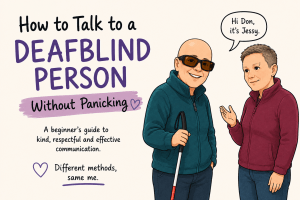
So, in the interest of helping humanity recover from its collective confusion, I present to you: a beginner’s guide to interacting with a Deafblind person. Or at least this Deafblind person. While every Deafblind individual is different, some of these tips may work for others too.
Let us begin.
Deafblind Does Not Mean Darkness and Silence
First things first: Deafblindness is a spectrum.
That I’m Deafblind does not mean I live in complete darkness and silence dramatically waiting for sonar signals like a confused bat. Many Deafblind people still have usable sight and/or hearing. I personally have some of both. The challenge is that neither works particularly well, especially together.
I still enjoy art, music, movies, gaming, travel, photography, concerts, restaurants, shopping trips, and generally existing out in the world like everyone else. I’m the one that will walk into a room with a sketchbook in one hand and white cane in the other. Or yse my cane outside as not to trip over objects or cracks in the pavement, while also carrying a DSLR camera. Sometimes I simply need to do things differently to achieve the same result.
So please don’t assume my life is sad, empty, or limited to sitting in a dark room contemplating wallpaper textures.
Please Get My Attention Before Speaking
If you start talking while I’m focused elsewhere, there’s a very high chance your words will dissolve into mysterious background soup.
Say my name first. Wait for me to look roughly in your direction. Then speak.
This increases the odds of me understanding you from approximately 12% to something significantly more encouraging.
Tell Me Who You Are
I don’t see well enough to recognize faces and I don’t hear well enough to reliably recognize voices.
So when greeting me, please say your name.
Not because I’m rude.
Not because I forgot you exist.
But because my brain is essentially trying to identify humans using broken WiFi signals.
A simple:
“Hey CJ, it’s Sarah.”
…works wonders.
Face Me When You Speak
I cannot see enough to lipread, but the direction of your voice matters enormously.
Your voice is clearest when you’re facing me directly. If you’re talking while looking at your phone, staring into a shop window, walking three meters ahead of me, or yelling from another room while operating a kettle, your words become distorted.
And yes, I will ask you to repeat yourself.
Probably more than once.
Please Don’t Shout
Hearing aids help me hear more, but they do not magically restore normal hearing.
Shouting often makes speech less clear, not more.
Think of it this way:
If a blurry photograph is enlarged, it’s still blurry. Just bigger.
Clear speech works better than loud speech.
The Great Tray Incident
Hearing loss can create some truly spectacular misunderstandings.
For example, certain sounds blur together for me. F and S can sound similar. So can P and B.
One evening after dinner, Jessy casually announced:
“I need to clean this tray.”
What my brain heard was:
“I’m gonna pee on this tray.”
Naturally, I had concerns.
After asking her — with considerable alarm — why she intended to do such a thing, she repeated herself and we finally solved the mystery.
Communication really is magical.
Groups Are My Natural Predator
Family gatherings, birthday parties, restaurants, and group outings are wonderful.
They are also exhausting.
Imagine six conversations happening at once, cutlery clattering, music playing, someone laughing loudly behind you, and your brain desperately trying to assemble incomplete audio fragments into coherent language.
That’s what group conversations can feel like for me.
I love social situations, but I simultaneously dread them because listening takes enormous concentration. Sometimes the exhaustion is so intense that hours later, while lying in bed, my brain is still trying to process conversations from earlier in the evening.
It’s like mental buffering that refuses to stop.
Medical appointments can also be difficult, especially when I’m doing most of the talking myself. Trying to monitor my own speech volume while listening carefully often leaves my vocal cords aching and my brain feeling like melted pudding.
Offer Help. Don’t Assume I Need It.
Always offering help is kind.
Automatically deciding I cannot do something is not.
Please ask first.
Something as simple as:
“Would you like a hand?”
…gives me the chance to decide what I can manage independently.
Independence matters a lot when you live with disabilities. Sometimes I genuinely need assistance. Sometimes I absolutely do not.
Let me choose.
“Over There” Is Not a Location
If I ask where something is, pointing vaguely and saying:
“Over there.”
…does not help.
Where is “there” exactly?
Northwest?
Next to the thing?
Beyond the other thing?
Narnia?
Detailed directions help enormously. Better yet, walk with me and show me.
How to Guide Me Without Accidentally Injuring Me
If you’re guiding me somewhere, please let me hold your elbow.
This allows me to feel your movements, detect obstacles, notice stairs, and understand changes in pace or direction.
Please do not grab me by the elbow and drag me around.
Apart from making me feel like a cow being herded into a stall, it’s also dangerous. I have hypermobility, meaning my joints are looser than they should be, and my shoulder can partially dislocate very easily.
And I’m fairly certain you’re not planning to spend your afternoon in hospital with me.
The Best Help Is Often Simple Communication
One of the kindest things anyone has done for me happened on a walking route near my house.
There’s a row of driveways I pass regularly. One day, a woman whose car was parked differently than usual simply said:
“My car door is open a little further forward today.”
That was it.
No panic.
No drama.
No awkwardness.
Just useful information delivered normally.
I safely navigated around the obstacle and continued my walk.
That kind of communication means more than people realize.
Lighting Matters More Than You Think
If you stand with a bright window behind you, I mostly see a shadow.
Your facial expressions disappear. Your body language disappears. Any sign language becomes much harder to follow.
Soft lighting facing toward your face helps me tremendously.
Please Respect the “No Talking With Your Mouth Full” Rule
Your mother taught you this for a reason.
Not only is it mildly horrifying, but chewing also distorts speech.
I want to hear you.
Not your half-processed sandwich.
Sign Language Helps More Than You Know
I use sign-supported Dutch because it reduces the mental strain that listening causes.
If you can sign while speaking, it helps enormously. My brain can combine visual information with the words I partially hear, which dramatically improves understanding and reduces listening fatigue.
It’s honestly one of the most calming forms of communication I’ve ever experienced.
Disability Jokes Require Friendship DLC
Making jokes about my hearing or sight loss is reserved for close friends and family members only.
Those people have earned the expansion pack.
Random strangers have not.
Final Thoughts
The truth is, most Deafblind people are not expecting perfection. We simply appreciate patience, communication, and willingness to adapt a little.
Small adjustments make a huge difference.
And perhaps most importantly: please don’t be afraid to interact with us. We are still people. Slightly complicated people, perhaps. But people nonetheless.
If you made it to the end of this blog, congratulations. You are now significantly less likely to accidentally herd a Deafblind person like livestock.
And honestly, that’s progress.

